
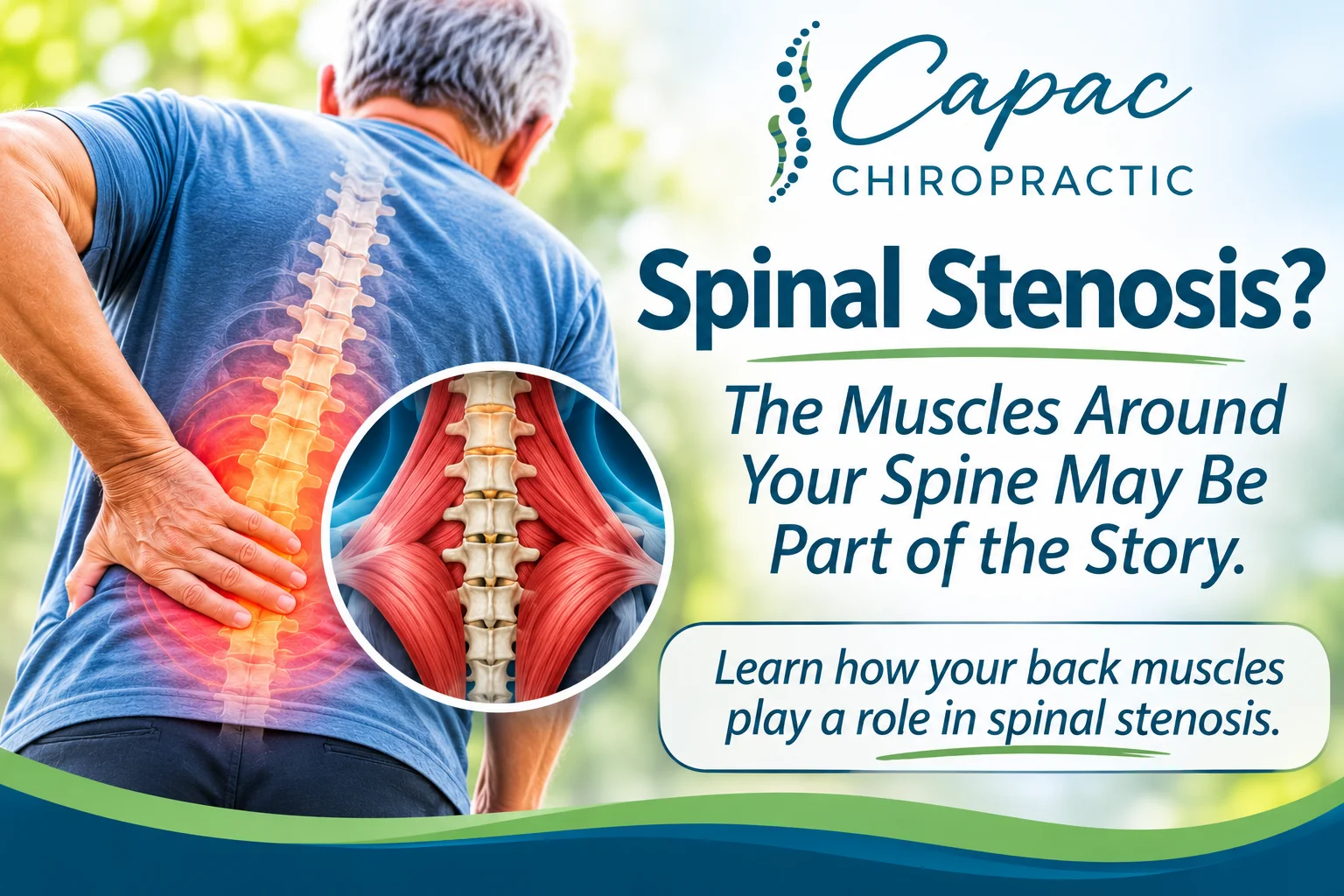
If you experience lower back pain, leg pain, or discomfort when standing and walking, spinal stenosis may be one possible explanation. But there's more to understanding spinal stenosis than simply looking at how narrow the spinal canal has become.
The muscles surrounding your spine also play an important role in supporting your back, controlling movement, and helping maintain stability.
Recent research has explored the relationship between lumbar spinal stenosis, spinal instability, and the size of the muscles that help stabilize the lower back. The findings offer another reason why a thorough evaluation should consider both the structure of your spine and the muscles that support it.
At Capac Chiropractic, we believe understanding how the spine and surrounding muscles work together is an important part of evaluating back pain and movement concerns.
What Is Spinal Stenosis?
Spinal stenosis occurs when the spaces within the spine become narrower. This narrowing can put pressure on nearby nerves, potentially leading to pain and other symptoms.
Although spinal stenosis can occur in different areas of the spine, lumbar spinal stenosis affects the lower back.
Common symptoms may include:
- Lower back pain or stiffness
- Pain that travels into the buttocks or legs
- Numbness or tingling in the legs or feet
- Leg weakness or a feeling of heaviness
- Discomfort that increases with standing or walking
- Symptoms that improve when sitting or bending forward
Not everyone with spinal stenosis experiences symptoms. The severity and location of the narrowing, along with other individual factors, can influence how a person feels and moves.
What Is Spinal Instability?
Your spine is made up of individual bones called vertebrae. These bones are connected by joints, ligaments, discs, and other supporting structures.
A small amount of movement between spinal segments is normal and necessary. However, when one segment moves more than expected, it may be described as spinal segmental instability.
This additional movement can affect how forces are distributed throughout the spine.
Spinal stability depends on several structures working together, including:
- Bones and joints: Provide the structural foundation of the spine
- Ligaments: Help support and limit excessive movement
- Muscles: Provide active support and help control spinal movement
- Nervous system: Coordinates muscle activity and movement
When one part of this system isn't functioning as expected, the other structures may have to compensate.
The Role of Deep Stabilizing Muscles
Not all back muscles perform the same job.
Some muscles are primarily responsible for larger movements, while others help provide more localized support and control around individual spinal segments.
Two important muscles in this discussion are the multifidus and psoas major.
The Multifidus
The multifidus is a group of deep muscles that run along the back of the spine.
These muscles help control spinal movement and provide support during everyday activities such as walking, bending, lifting, and standing.
Because the multifidus is closely connected to individual spinal segments, it plays an important role in local spinal stability.
The Psoas Major
The psoas major is a deep muscle that connects the lumbar spine to the upper thigh bone.
It plays an important role in hip movement and also contributes to controlling the position and movement of the lower back.
Together with other muscles, the psoas helps coordinate movement between the spine, pelvis, and hips.
What Does the New Research Say?
A study by Ahn and colleagues, published online in September 2026 in the Journal of Back and Musculoskeletal Rehabilitation, examined the relationship between spinal instability and the size of the muscles surrounding the lower back in people with lumbar spinal stenosis.
Researchers evaluated 97 people with lumbar spinal stenosis. They compared participants with and without lumbar segmental instability using spinal imaging and measurements of the surrounding muscles.
The researchers found that participants who also had spinal segmental instability tended to have smaller:
- Multifidus muscles
- Psoas major muscles
Interestingly, the researchers did not find significant differences in the size of the erector spinae muscles between the groups.
The study suggests that spinal instability may be associated with changes in specific muscles that help support and control the lower back.
Why does this matter?
It highlights the importance of looking beyond the spinal canal itself. The muscles surrounding the spine may also provide useful information when evaluating someone with spinal stenosis and possible instability.
It's important to understand that this was a retrospective, cross-sectional study. It identified an association between instability and smaller muscle size, but it cannot establish which came first or prove that one caused the other.
Why a Thorough Evaluation Matters
Two people can have similar findings on a spinal MRI but experience very different symptoms.
That's because imaging is only one part of understanding back and leg pain. A complete evaluation may also consider:
- Where your pain is located
- Whether symptoms travel into your legs
- How long you can comfortably stand or walk
- Whether certain positions make symptoms better or worse
- Your strength, balance, and mobility
- How your spine and surrounding muscles work during movement
Understanding these factors can help healthcare professionals determine what may be contributing to your symptoms and which treatment options are appropriate.
Can Chiropractic Care Help With Spinal Stenosis?
Spinal stenosis is a structural condition, and chiropractic care does not reverse the narrowing of the spinal canal or guarantee that nerve compression will go away.
However, an individualized evaluation may help determine whether musculoskeletal issues, movement restrictions, or other factors are contributing to your discomfort.
Depending on your symptoms and examination findings, a care plan may include appropriate chiropractic treatment, movement recommendations, and exercises or other conservative strategies when suitable.
Not every patient with spinal stenosis is a candidate for spinal manipulation. Treatment should be selected based on the individual's symptoms, medical history, imaging findings when available, and overall health.
In some cases, referral to another healthcare professional or a spine specialist may be the most appropriate next step.
When Should You Seek Medical Attention?
If you have persistent back pain, leg pain, numbness, or difficulty walking, it's important to have your symptoms evaluated.
Seek emergency medical attention if you develop new loss of bladder or bowel control, numbness around the groin or saddle area, or sudden or rapidly worsening leg weakness. These symptoms can indicate serious nerve compression.
Looking for a Chiropractor in Capac, Michigan?
Living with spinal stenosis can make everyday activities more challenging, but understanding what's contributing to your symptoms is an important first step.
At Capac Chiropractic, we take an individualized approach to evaluating back pain, mobility concerns, and the way your spine and surrounding muscles work together.
If you're searching for a chiropractor in Capac, Michigan, and spinal stenosis or lower back pain is affecting your daily life, contact our office to discuss whether an evaluation may be appropriate.
Your spine is more than a collection of bones. The muscles, joints, and supporting structures all work together to help you move. Understanding the whole picture matters.